HCI Research · Virtual Reality · Behavioral Analysis · 2024–2026
Understanding Human Behavior in Virtual Environments
Studying how people navigate, interpret, and experience virtual buildings—and how behavioral and physiological signals can help evaluate spatial design before construction.
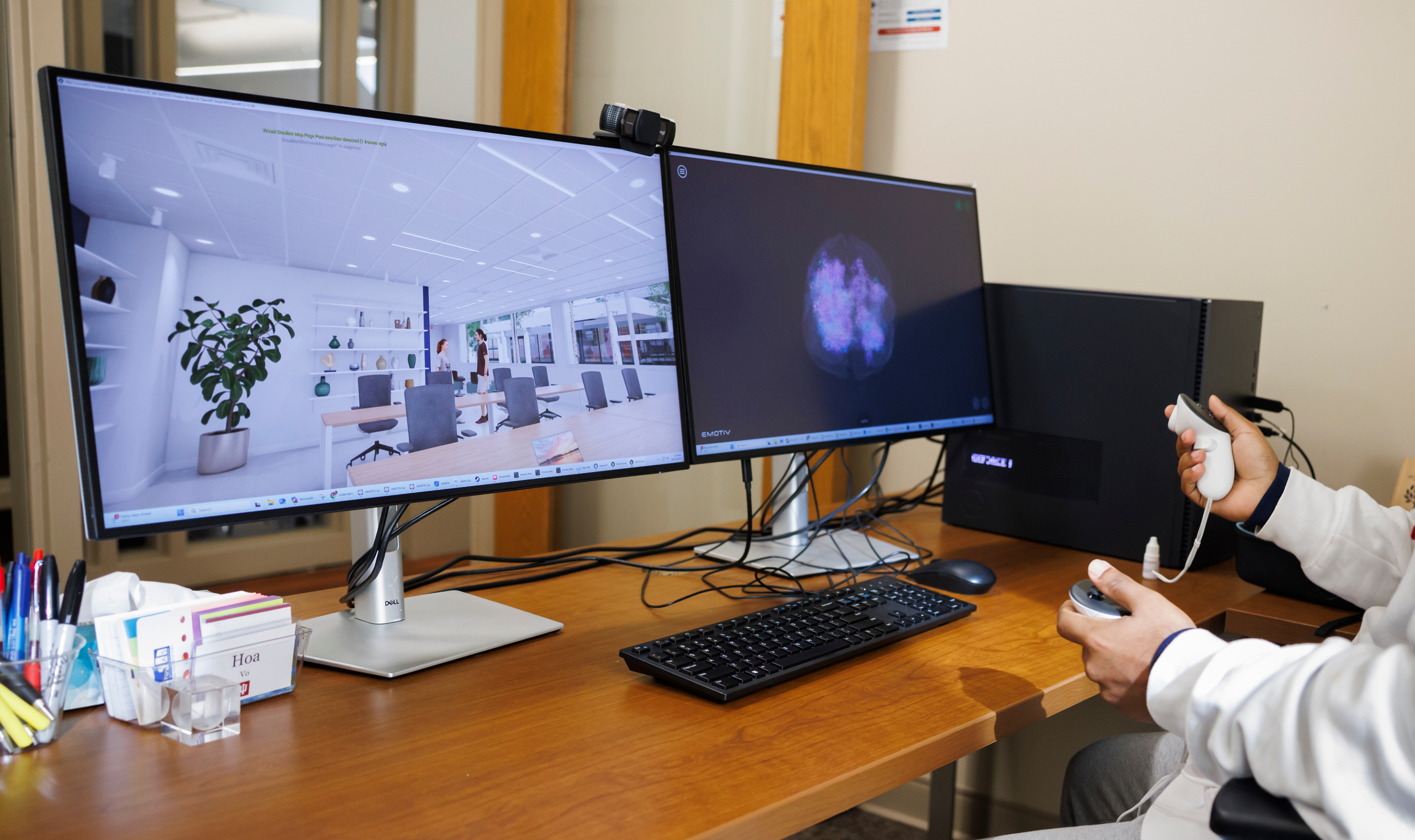
Overview
This research investigates whether people's behavior in immersive virtual environments can reveal spatial usability issues before architectural spaces are physically built.
The published study included a 102-participant pilot in a virtual office and a 65-participant follow-up in a virtual art studio. Participants explored the environments while egocentric VR recordings captured how they moved through and responded to the space.
These recordings were used to study behavioral patterns such as room visitation, doorway entry, pausing, and movement, and to train a Vision Transformer to classify where people were moving within the virtual environment.
- Role
- HCI Researcher · Co-author
- Context
- Intelligent Perceptual Design Lab
- Studies
- 102-participant pilot · 155-participant follow-up
- Focus
- VR · Behavior · Spatial usability
What I did
I contributed to immersive user studies, behavioral data collection and interpretation, study execution, and research communication. My work connected what participants did inside the virtual environments with questions about navigation, spatial understanding, and usability.
I also contributed to manuscript preparation and presentation of the published research, while continuing the broader research program through additional qualitative and physiological studies.
Outcome
Spatial adjacency did not guarantee usability. We realized that the spaces themselves, rather than their layout, influenced how people interacted with them.
The follow-up Vision Transformer reached 96% classification accuracy. Together, the results suggest that behavioral signals collected in VR can reveal aspects of spatial experience that are difficult to infer from a floor plan alone.
Extended research
The work expanded beyond movement classification into mixed-methods studies examining how people experience and interpret immersive environments.
01
Think-aloud studies
Think-aloud protocols helped capture what participants noticed, expected, and found confusing while navigating immersive spaces, adding qualitative context to observed movement behavior.
02
EEG + VR studies
Follow-up research incorporated EEG data collection alongside think-aloud protocols to examine physiological responses during immersive spatial experiences and extend behavioral analysis beyond movement alone.
Published research
Mapping Indoor Travel Patterns with Virtual Reality and Vision Transformer · eCAADe 2026